The Waldo County Amateur Radio Association participated in
ARRL Field Day. We made several hundred contacts, learned a lot, ate good food, and had fun together. What follows is a description of our setup, results, and early plans for next year based on what we learned.
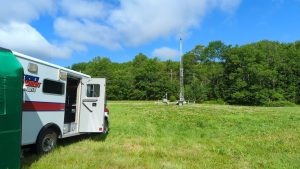
Setup
Our club is lucky to have a good relationship with the
Waldo County Emergency Management Agency (Waldo EMA), whose facility in Swanville ME sits on about 60 acres. We ran our Field Day operations on the Waldo EMA grounds for the second time this year, and we hope to be allowed to continue doing so in the future. This location gives us access to more than enough space to spread out our antennas with access to a kitchen, bathroom, and lots of equipment a short walk away.
We operated as a 3A station, with one transceiver per major mode (PH, CW, and digital). While we could have chosen class F (Emergency Operations Center), we prefer to operate in class A and are careful to separate our Field Day operations from the Waldo EMA infrastructure. Notably, we put up antennas on a temporary basis far from the EOC, and we only use gas generators and solar panels with batteries for power. We don’t consider the EOC to be part of our station, and we don’t depend on it directly for operation.
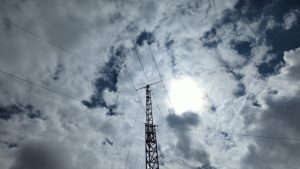
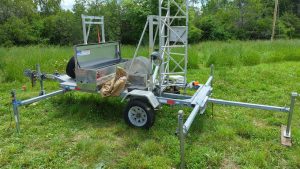
The PH and CW stations had two antennas each. One was a beam for the higher HF bands on top of a portable aluminum tower, and the other was a wire antenna for 40 and 80 m. During setup on Friday, we placed these about 850 feet apart along a roughly NNW/SSE line and pointed the beams towards the middle of the country. We’ve struggled with cross-band interference due to antennas being too close in previous years, so we decided to try this idea and were happy with the results. (I describe this further below.) We placed the digital station more or less equidistant from both of the other stations and used an SGC-230 antenna coupler with a random wire. The coupler is an interesting device that seems to no longer be in production. After some convincing, it worked quite well and was able to tune the wire for all relevant bands.
The PH and CW stations both used IC-7300 radios and had a second operating position for a logger. We used the N3FJP Field Day logging software on Windows laptops at these stations. For the digital station, we used the internal logging feature of WSJT-X on an Xubuntu laptop as well as Winlink on a Windows laptop. None of the machines had access to any network (even amongst themselves) with some brief exceptions when using cell phone hotspots. At all times we remained at or below 100 W of transmitter power.
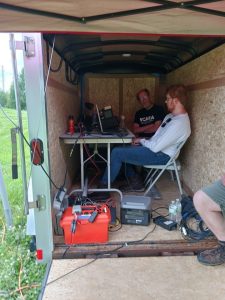
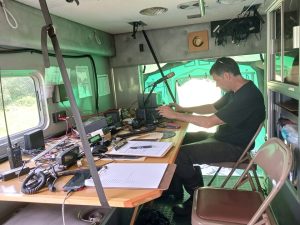
The operators for the CW and digital stations sat in covered trailers, and the PH station used the Waldo EMA’s communications truck, which is a converted ambulance. The PH station attached an inflatable tent to the back of the truck for more shade, and the digital station used a more traditional folding tent. The CW station used a mesh mosquito net on one of the doors to the trailer.
The weather forecast going into the weekend was predicted mostly clear skies with high temperatures in the upper 70s and lower 80s, dew point in the low 60s, low wind, and the possibility of thunderstorms. We didn’t encounter substantial lightning, but we still disconnected our equipment before leaving the stations for the night. The
space weather forecast called for noisy conditions on the bands, especially during the day, but not so much noise that we expected to be unable to operate.
Results
In total, we made
618 contacts across
65 of 85 sections. We worked
43 of 50 states (plus Puerto Rico) and
5 of 10 Canadian provinces. The tables below show the distribution of contacts across modes and bands. You can download our combined contact log
here.
| Mode |
Contacts |
| PH |
379 |
| CW |
134 |
| DG |
105 |
| Band (m) |
Contacts |
| 80 |
54 |
| 40 |
121 |
| 20 |
364 |
| 15 |
63 |
| 10 |
16 |
The digital station also sent 13 Winlink messages in ICS-213 format using VARA HF, including one message to our ARRL Section Manager, and copied the W1AW bulletin on Saturday night. These extra activities counted for 300 points, equivalent to 150 digital/CW contacts or 300 phone contacts.
The performance of our antenna systems with respect to interference exceeded our expectations. For the most part, none of the stations reported any interference whatsoever. The phone station did report some interference from the digital station when both were operating on the same band, but this wasn’t enough to cause substantial problems. Before disassembling the antennas, we intentionally put all of our stations on the 20 m band and were unable to hear each other. We will probably continue to use this arrangement or one like it in the future.
Due to the digital station’s use of an antenna coupler, it was possible to tune the random wire on the 160 m band. This band has historically been out of reach for our club, but we were able to get a roughly 2:1 SWR out of the coupler. We called CQ on the FT8 segment but got no response and saw no activity. It’s possible that the coupler fooled us and our setup wasn’t actually suitable for 160. We ran this test during the middle of the day, so in all likelihood the band was simply closed.
Next Year
The biggest improvement we want to make for Field Day 2027 is to gather all stations closer together in a central camp. We’ve done this in previous years and found it much more fun, but we also placed our antennas closer together in those cases and suffered from interference, even across bands. Spreading out the antennas this year resulted in excellent technical performance but made socializing harder. Our club will probably invest in several hundred feet of coax so we can keep the antennas far apart but run feedlines to a central location. The relatively small feedline loss from such a setup is likely to be worth the extra fun of being colocated.
Some other ideas for improving our Field Day activities include:
- setting up a GOTA station with dedicated operators
- buying a club VARA license to get access to higher Winlink speeds
- putting on an educational activity, such as a fox hunt
- connecting all computers to a LAN
- making a serious attempt at a satellite contact
- establishing a dedicated night crew so we can operate for all 24 hours
- recruiting or training more CW operators
- generating more public interest, especially among younger people
